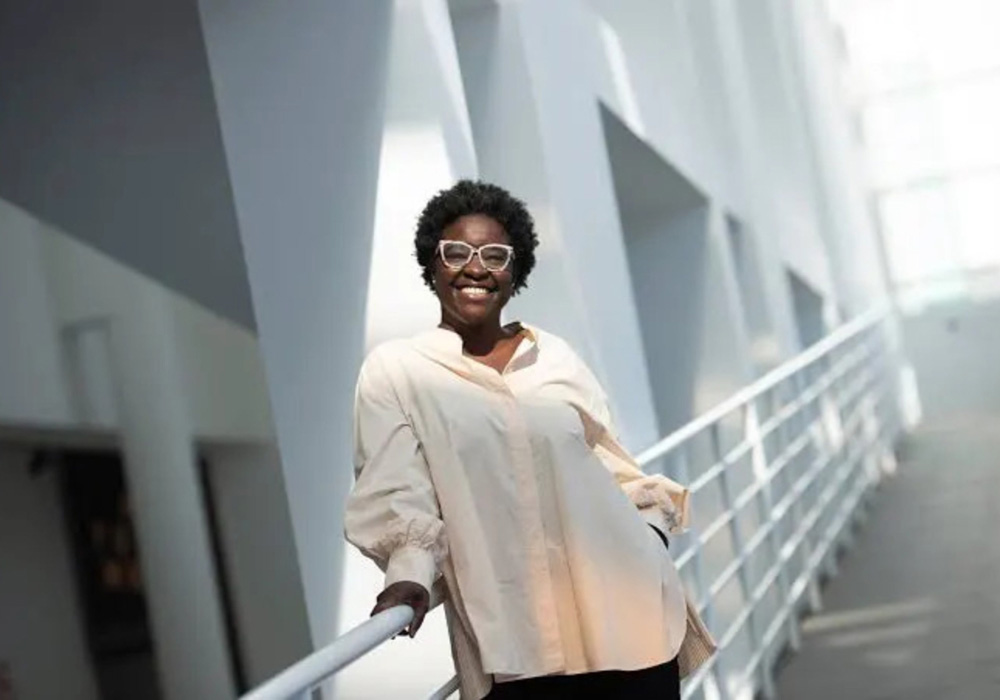
International curator Elvira Dyangani Ose will lead the second Public Art Abu Dhabi Biennial, launching in autumn 2026. The upcoming edition promises a bold new chapter for the city’s public art landscape, blending global perspectives with local contexts through large-scale installations and community-driven placemaking.
Abu Dhabi is preparing for another ambitious chapter in its growing public art story.
The Department of Culture and Tourism – Abu Dhabi has announced the appointment of internationally acclaimed curator Elvira Dyangani Ose as Artistic Director of the second edition of the Public Art Abu Dhabi Biennial, set to open in autumn 2026 and run into 2027.
Building on the momentum of its inaugural edition, the biennial will once again transform the emirate into a large-scale, open-air platform for contemporary artistic expression, community engagement, and cultural dialogue.
Dyangani Ose, currently Director of MACBA (Museu d’Art Contemporani de Barcelona), brings with her a global curatorial practice shaped by leading institutions including Tate Modern, Creative Time, The Showroom London, and Fondazione Prada. Her appointment signals Abu Dhabi's continued commitment to ambitious, research-driven public programming that connects international artistic perspectives with local contexts.
A proven foundation for public art
The first edition of Public Art Abu Dhabi Biennial, which ran from November 2024 to April 2025 across Abu Dhabi and Al Ain, established the initiative as a major regional platform for site-specific contemporary art. Featuring installations by artists from the UAE and around the world, the biennial is embedded in the urban fabric; many were later acquired as permanent additions to the emirate’s public realm.
Artists from the inaugural edition included Kader Attia, Superflex, Nathan Coley, Wael Al Awar, Farah Al Qassimi, and Shaikha Al Ketbi, underscoring the biennial’s commitment to presenting both international voices and homegrown talent. The result was a citywide experience that invited residents and visitors alike to encounter art beyond traditional gallery spaces.
With Dyangani Ose now at the helm, the second edition is expected to deepen this model, further positioning Abu Dhabi as a destination where public space becomes a site of artistic exchange and collective reflection.
Curating through history, community, and collective memory
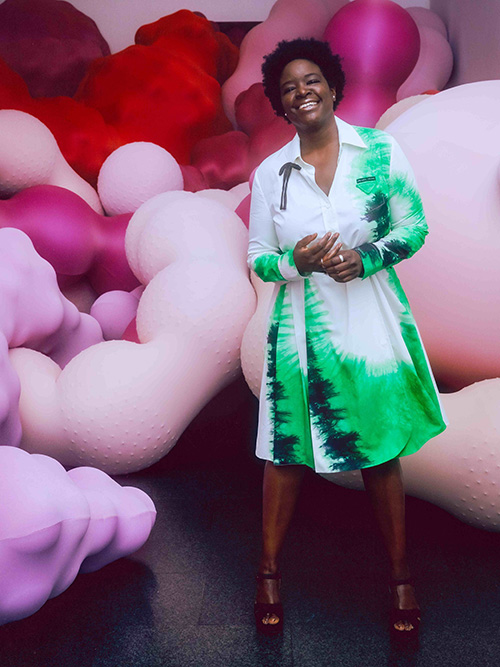
Dyangani Ose’s curatorial approach is known for its multidisciplinary scope and critical engagement with history, representation, and public space. Her projects frequently explore how narratives are constructed, whose stories are amplified, and how non-Western knowledge systems can be brought into contemporary artistic discourse.
Recent initiatives such as Project a Black Planet – The Art and Culture of Panafrica, Coco Fusco: I Learned to Swim On Dry Land, and Goshka Macuga’s Miu Miu Tales and Tellers reflect her commitment to participatory experiences and expansive cultural perspectives.
Her academic background further reinforces this approach. Dyangani Ose holds a degree in Art History from Universitat Autònoma de Barcelona, a Master of Arts from Cornell University—where she is currently completing a doctorate in Visual Studies—and advanced studies in architecture theory and history from Universitat Politècnica de Catalunya. She has also taught at Goldsmiths, University of London, where she specializes in museology, curating, Black Studies, and contemporary African art.
This blend of scholarly rigour and curatorial innovation positions her uniquely to shape a biennial that speaks to both Abu Dhabi’s evolving cultural identity and broader global conversations.
Public art as placemaking
Public Art Abu Dhabi is a long-term initiative of the Department of Culture and Tourism – Abu Dhabi, centred on commissioning permanent and temporary artworks that enhance liveability, wellbeing, and cultural infrastructure across the emirate. Beyond exhibitions, the program emphasizes community engagement, placemaking, and the creation of shared cultural memory.
Alongside the biennial, the initiative also delivers Manar Abu Dhabi and other projects that activate public spaces while strengthening the city’s creative ecosystem. Together, these efforts reflect Abu Dhabi’s broader vision of integrating culture into everyday life—where art is not confined to institutions, but experienced across neighbourhoods, landscapes, and daily routines.
As preparations begin for the 2026–2027 edition, further details—including participating artists and locations—will be announced in the coming months. For now, Dyangani Ose’s appointment offers a compelling glimpse into what lies ahead: a biennial shaped by thoughtful curatorial leadership, global perspectives, and a deep engagement with place.
In an era when cities are increasingly defined by their cultural ambition, Public Art Abu Dhabi continues to demonstrate how public art can serve as both creative expression and civic infrastructure, inviting communities to see their surroundings anew.